Memory: A Cognitive Architecture Process
From context to memory
- Memory is the architectural substrate that gives intelligent systems continuity, learning, and adaptive behavior beyond temporary context.
- What needs to be considered by AI architects, researchers, and engineers designing systems that must retain experience, reason across time, and act reliably.
- GPT-like models expose context limits, making structured, persistent memory increasingly essential for capable, long-running AI agents.
Why context is not enough for cognitive architecture
In a previous post, cognitive architecture was framed as a blueprint for intelligent systems: not a single model, but an organized coordination of perception, memory, reasoning, learning, and action. Memory was introduced as one of the core processes needed to move from model-centric AI toward systems that can adapt, explain, and act over time.
This post explores memory.
Memory is often treated as storage: a database, a cache, a transcript, a folder, a log, a vector store. But for cognitive architectures, memory is more than storage. It is the mechanism by which a system preserves useful state, retrieves it when needed, updates it when new evidence arrives, and lets past experience influence future behavior.
A system without memory can still respond. It can still classify, generate, summarize, or predict. But it cannot truly accumulate experience. It cannot know what it has already tried, what failed, what matters to a user, what changed in the environment, or which procedure should be reused. Without memory, intelligence becomes reactive. With memory, intelligence becomes adaptive.
What is memory?
At the broadest level, memory is retained information that can influence future processing. In biological systems, this includes the ability to encode experience, store it, consolidate it, and retrieve it later. In engineered systems, it includes mechanisms for storing state, parameters, records, patterns, relationships, and procedures so that computation does not start from zero every time.
This distinction matters. Memory is not simply all past data. A complete video recording of everything a person has seen is not equivalent to human memory. A full chat transcript is not equivalent to an agent’s memory. Memory is selective. It is organized. It is shaped by attention, importance, repetition, emotion, goals, and use.
Neuroscience and psychology have long moved away from treating memory as one single faculty. Modern memory research distinguishes between multiple systems with different operating principles and different neural substrates: conscious recollection of facts and events, unconscious skill and habit learning, short-term maintenance, and active working memory used during cognition.
From an engineering perspective, that is an important lesson: different kinds of information require different memory mechanisms.
Why do intelligent systems need memory?
Memory gives an intelligent system continuity.
For a human, continuity means that yesterday’s experience can shape today’s decision. For a machine, continuity means that previous observations, user preferences, design constraints, failures, procedures, and learned abstractions can be reused rather than rediscovered.
A memory-enabled system can:
- maintain context across time
- avoid repeating mistakes
- personalize its behavior
- build domain knowledge
- detect change
- support auditability and provenance
- learn procedures from repeated experience
- and coordinate action over longer horizons
This is especially important in engineering and design environments. A system that assists with building design, manufacturing, construction, simulation, or maintenance cannot operate only on the current prompt. It needs to remember constraints, decisions, dependencies, failures, assumptions, schedules, standards, and prior interactions. Intelligence in these settings is not only about generating the next output; it is about preserving the right state for the next action.
Types of memory: biological and engineered views
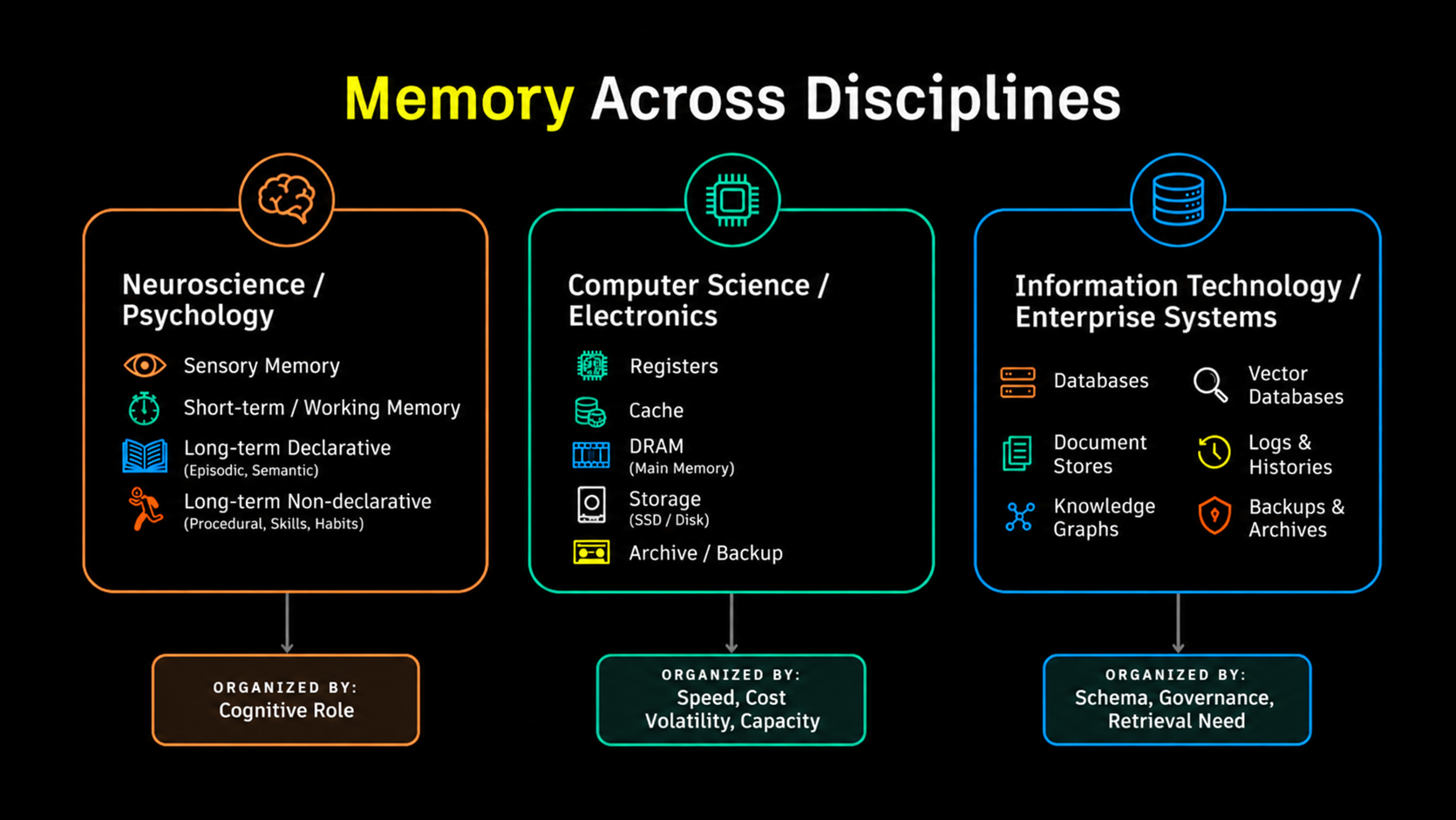
Psychology and neuroscience often classify memory by function. A simplified view includes sensory memory, short-term memory, working memory, and long-term memory. Long-term memory is commonly divided into declarative memory, which includes facts and events, and non-declarative memory, which includes skills, habits, priming, and conditioning. Episodic memory helps preserve events in time and context. Semantic memory supports generalized knowledge. Procedural memory supports learned ways of doing things. Working memory acts as the active workspace used to hold and manipulate information for the current task.
Computer science and electronics classify memory differently. The concern is often latency, cost, volatility, capacity, addressability, and persistence. A computer memory hierarchy ranges from registers and cache, to DRAM, to disks, flash, and backup storage. The higher levels are faster, smaller, and more expensive; the lower levels are slower, larger, and cheaper. Modern operating systems also use virtual memory to move information between RAM and storage as needed.
Information technology adds another layer: logs, relational databases, document stores, object stores, knowledge graphs, vector databases, metadata catalogs, version histories, access-control systems, and backup archives. These are all memory-like systems, but they optimize for different things: exact lookup, semantic retrieval, durability, compliance, traceability, scale, or analytics.
The key insight is that memory is not one thing. In biology, memory differs by cognitive role. In computing, it differs by physical and architectural constraint. In enterprise systems, it differs by schema, governance, and retrieval need.
Memory in existing digital solutions and its limits
Digital systems already use memory everywhere: Browsers remember sessions. CAD tools remember version histories. Recommendation engines remember behavior. Databases remember transactions. Caches remember recently used data. Digital twins remember state. Search engines remember indexed documents. Enterprise systems remember people, permissions, projects, assets, schedules, and decisions.
These systems are powerful, but most are not cognitive memories. They store information, but they rarely understand how that information should participate in perception, reasoning, planning, and action.
A database can store what happened, but not always why it mattered. A log can preserve sequence, but not necessarily causal relevance. A vector database can retrieve similar text, but similarity is not the same as usefulness. A cache can accelerate access, but it does not know whether a memory should be consolidated, contradicted, forgotten, or promoted into a more stable abstraction.
Retrieval-augmented generation partly addresses this by combining parametric knowledge inside a model with non-parametric external memory, such as a dense vector index. RAG improved the ability of language models to access external knowledge and generate more specific responses, but it is still primarily a retrieval mechanism rather than a complete memory architecture.
The limitation is architectural: most digital memory systems are passive stores. Cognitive architectures need active memory systems.
Context is not memory. It is history.
This becomes especially important for large language models.
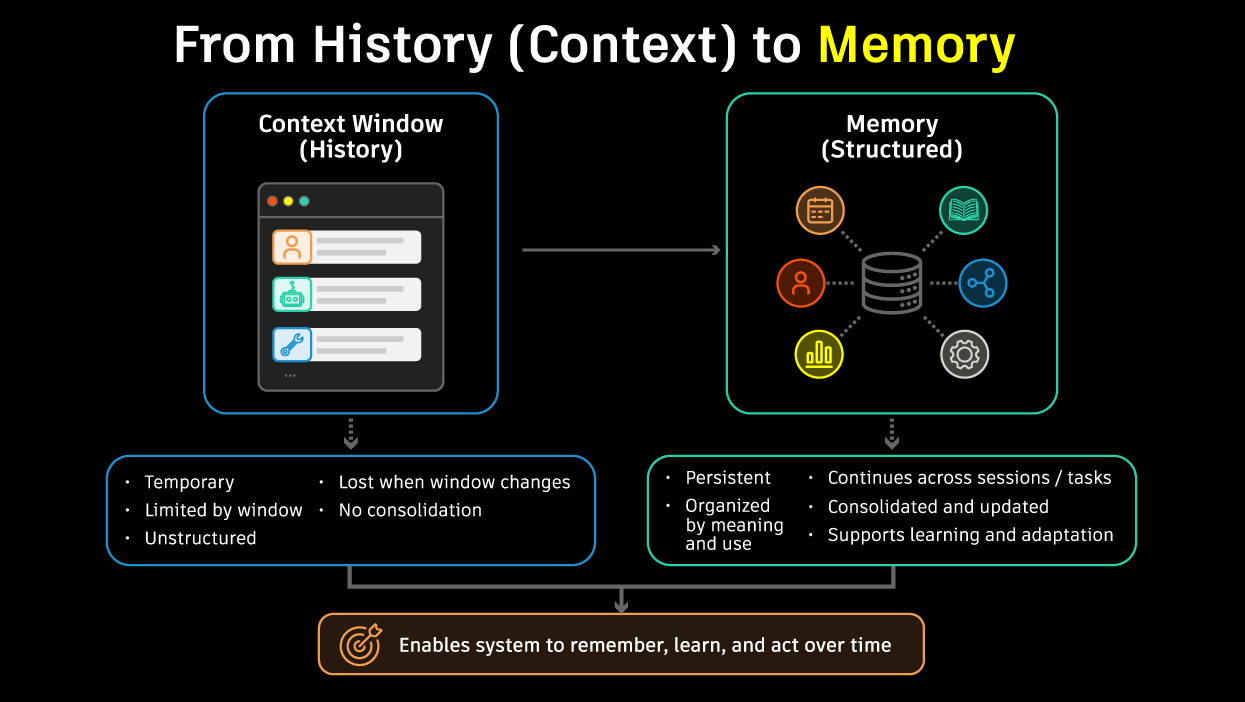
In many LLM applications, memory is used to describe the context window: the system prompt, user prompt, conversation history, tool outputs, retrieved documents, and other tokens passed to the model at inference time. But context is not memory in the cognitive sense. Context is the current working surface. It is the information made available right now.
Anthropic defines context as the set of tokens included when sampling from an LLM, and context engineering as the discipline of curating those tokens under finite constraints. That is a useful engineering framing, but it also reveals the limitation. The context window is not a durable, structured memory store. It is closer to a temporary workspace.
A chat transcript placed in context is not memory; it is history replay. The model is not remembering in the same way a cognitive architecture should remember. It is re-reading selected history and generating a response conditioned on that history. Once the window changes, the accessible memory changes.
Longer context windows help, but they do not solve memory. Research on long-context models shows that performance can degrade depending on where relevant information appears in the input; models often use information at the beginning or end of the context better than information in the middle.
This is why simply increasing context length is not equivalent to building memory. Bigger windows give the system a larger scratchpad. They do not automatically provide consolidation, salience, abstraction, provenance, contradiction handling, forgetting, or modular retrieval.
How memory is being rethought for LLMs
LLM systems are now moving from prompt-only designs toward memory-augmented agents. Several patterns are emerging.
One pattern is retrieval-augmented memory: store external knowledge and retrieve relevant pieces at inference time. Another is reflective memory: store observations, summarize them, and synthesize higher-level reflections. Generative Agents, for example, used a memory stream of agent experiences, synthesized reflections, and dynamically retrieved memories to support planning and behavior.
Another pattern is hierarchical memory management. MemGPT explicitly draws inspiration from operating-system memory hierarchies, using “virtual context management” to move information between faster and slower memory tiers while operating within a limited LLM context window.
Recent surveys describe LLM agent memory as a write–manage–read loop: deciding what to store, how to organize it, what to retrieve, how to resolve contradictions, how to control cost and latency, and how to support privacy and deletion.
This shift is important. The question is no longer only “How much context can the model accept?” The question is “What memory architecture should surround the model?”
Toward structured memory stores for cognitive architectures
For cognitive architectures, memory should be treated as a first-class architectural substrate.
A useful starting point is modularity. Different memory stores should serve different roles. A working memory store supports the current task. An episodic store preserves situated events. A semantic store holds generalized knowledge. A procedural store captures how tasks are performed. Other domain-specific stores may be added depending on the system, but the principle is the same: different memory functions deserve different representations, policies, and interfaces.
This modularity has practical benefits. It makes memory interpretable: we can ask where a belief came from. It makes memory maintainable: we can update one store without corrupting another. It makes memory safer: sensitive information can have different retention and access rules. It makes memory more useful: procedures can be retrieved differently from facts, and events can be retrieved differently from design constraints.
The key is not to copy the brain literally. The key is to learn from cognition as an organizing principle. Biological memory is selective, multi-system, and action oriented. Computer memory is hierarchical, constrained, and optimized. Enterprise memory is governed, structured, and durable. A cognitive architecture for AI should combine these lessons.
Memory should answer not only “What do we know?” but also:
- What happened?
- What changed?
- What is generally true?
- What procedure worked?
- What evidence supports this?
- What should be forgotten?
- What should be promoted into durable knowledge?
- What matters for the task right now?
This is where memory becomes more than storage. It becomes the substrate for learning, reasoning, and action.
Takeaway
The next generation of intelligent systems will not be built by adding larger prompts to larger models. They will require structured memory architectures around models.
Context gives an LLM temporary awareness. Memory gives a cognitive system continuity.
For cognitive architectures, memory must therefore be designed as a modular, structured, and governed system of stores: each with its own representation, retrieval logic, update policy, and role in the perception-reasoning-action loop. That is how AI systems move from responding to remembering, from remembering to learning, and from learning to acting intelligently over time.
Get in touch
Have we piqued your interest? Get in touch if you’d like to learn more about Autodesk Research, our projects, people, and potential collaboration opportunities
Contact us