Building Academic Connections and Advancing Simulation Research at WCCM/ECCOMAS 2026
Last month, a contingent of Autodesk Researchers attended the WCCM/ECCOMAS 2026 conference, where researchers from around the globe met to share ideas and discuss computational methods for physics and engineering.
Autodesk made a strong contribution, presenting six talks over the course of the week on topics ranging from digital twins for nuclear reactors to reduced order modeling of mechanical assemblies Attendees showed great interest in our contributions with talks spurring many insightful conversations, reinforcing Autodesk’s role as a valuable contributor to the academic research community.
We met with researchers and professors from all over the world, strengthening existing connections and opening promising new dialogues. Following these discussions, our team is excited to explore some topics that are new to us, including reduced order modeling for immersed boundary methods and imposing structure on geometry-generating latent spaces.
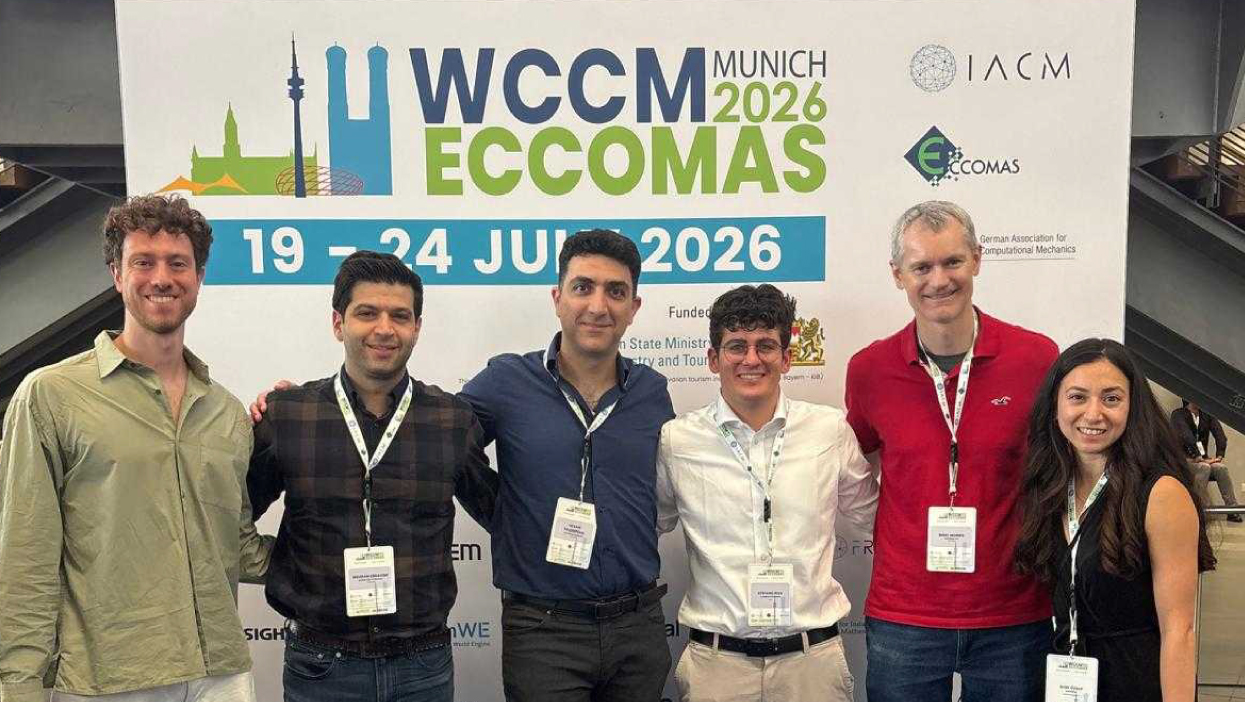
Autodesk Researchers presented the following topics:
- Paolo Conti: VENI, VINDy, VICI: a generative reduced-order modeling framework with uncertainty quantification
- Stefano Riva: Robust Monitoring of Nuclear Reactors from Sparse Sensors using Shallow Recurrent Decoders
- Hesam Salehipour: Interpretable Physics-Informed Reduced Order Modeling: Closing the Simulation-to-Data Gap
- Mehran Ebrahimi: An online spatio-temporal adaptive reduced basis element method for parameterized component-based nonlinear dynamical systems
- Adrian Butscher: Parametrized Geometry Transformation with Rigid Constraints for Model Order Reduction
- Adrian Humphry: Accelerating the Design of Components Within an Assembly Using Reduced Order Modeling of the Assembly Context
The WCCM/ECCOMAS 2026 conference highlighted the value of bringing together researchers from academia and industry to tackle some of engineering’s most complex challenges. For Autodesk, the event was an opportunity not only to share advances in physics-informed AI, reduced order modeling, and digital twins, but also to build new collaborations that will shape future research. As these conversations continue, the team looks forward to developing new ideas, strengthening partnerships, and advancing technologies that help engineers solve increasingly complex problems.
Get in touch
Have we piqued your interest? Get in touch if you’d like to learn more about Autodesk Research, our projects, people, and potential collaboration opportunities
Contact us