One Media and Entertainment Research team
Showcasing the Future at SIGGRAPH 2026
Media and Entertainment (M&E) Research focused its output and energy on SIGGRAPH 2026 in Los Angeles as the capstone engagement for the year. The team showed up with exciting prototypes, a vision for the future of animation, and an exciting new model for hair grooming that convinced some of their biggest skeptics. After much time sitting with what we’ve seen, these are thoughts from our M&E Research team on learnings, observations, and what the team hopes to see in 2027.
An Integrated Workflow – Validation of the StoryArc Thesis
Frederik Brudy, Principal Research Scientist
This was my first SIGGRAPH and I came away inspired by seeing the problems creatives in M&E are dealing with day to day.
I also had the chance to present StoryArc as part of the Autodesk Vision Series session on “What’s Next for Animation at Autodesk”. Most of my time, though, was spent on the show floor, where StoryArc was part of the Autodesk Research booth. For three days we gave live demos, talked with attendees, and used the opportunity to collect feedback.
A lot of the feedback reinforced why we’re building StoryArc in the first place. People we talked to saw value in connecting the different parts of pre-production that are traditionally spread across separate tools and workflows, and in being able to prototype and plan quickly while keeping those pieces connected. What surprised me was that StoryArc also gathered interest from customers in AEC and D&M, where they were imagining using StoryArc to idea, plan, and prepare a pitch for a product or advertising campaign.
GenAI came up in almost every conversation. There’s a tension here: Many creatives want AI as a tool they control, and creative work is much more than “prompt in, output out”. In StoryArc every step can be done manually, while gen AI can assist. That is very different from handing an entire production pipeline to an autonomous system. At the same time, I also met several people who were interested in exactly that: producing content as cheaply and quickly as possible.
The tone of these conversations has changed a lot from three years ago, when we often encountered pushback to GenAI in creative workflows. This year, many mid- and senior-level creatives were much more open to it though. Students and junior creatives, however, were more reserved, for an understandable reason: they see AI taking over work that traditionally gave people their first training and entry into the industry. If those tasks disappear, how do people build the experience needed to become senior creatives?
I left SIGGRAPH with a lot of feedback for StoryArc and a much-refreshed sense for the questions we will keep asking as we build tools for creative work.
Rigging and Animation Pros are Hungry for Breakthrough Solutions to old Problems
Essex Edwards, Motion Modeling Researcher
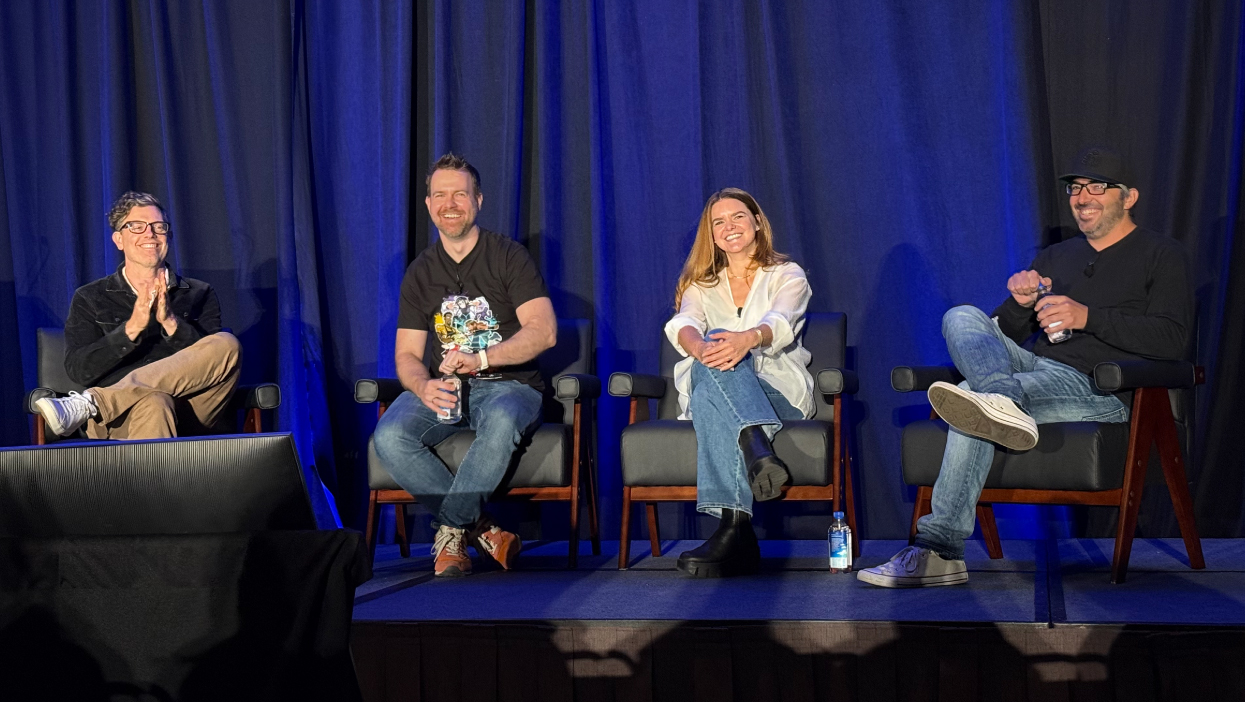
This was my first time attending the Rigging and Animation Birds of a Feather (BOF) events at SIGGRAPH. It was interesting to hear industry professionals from a variety of studios talking about the challenges they face in rigging/animation and what they are trying to do about it. The shocking thing was how little has changed in over a decade. The exact same discussions could all have been had in 2016. It seems like there’s a lot of agreement about what the problems are, but the solutions remain totally unclear to everyone. The users are hungry for better ways of working.
One thing that was clear from the BOF events is the wide disconnect between what rigging and animation users want their tools to do and what the AI/ML animation tools have been doing so far. Artists want control. They don’t want text-to-animation. I hope that next year we’ll see more artist-friendly applications of AI that take into consideration real-world requirements and workflows.
Shaping AI to fit Creative Workflows
Matthew Spremulli, Strategic Program Manager
I spent most of my time on the expo floor giving demos of StoryArc. What came through again and again was that creatives are looking for better ways to carry early ideas into downstream production without losing what made the idea good in the first place. GenAI has a real role in that stretch, not replacing the idea but helping it survive the trip from a napkin sketch to something a team can build from.
I also didn’t expect the range of people who were interested in this. It wasn’t just the classic M&E crowd; product designers and people thinking about physical spaces wanted the same thing: a way to structure a story and communicate an idea clearly.
The through-line across almost every conversation was control. Handing a result to a prompt and hoping felt like a dice roll, and that stopped being charming a while ago. Artists with real taste and a specific dramatic objective don’t want a slot machine; they want dials to steer and iterate deliberately.
What struck me most was how different the room felt from just two years ago. Back then, conversations about AI were mostly defensive. This year that had largely flipped: people aren’t asking whether AI belongs in their process anymore, they’re asking how to bend it into a shape that fits their standards.
Automation and Tooling for Motion Labelling Addresses a Clear Need
Olivier Zurcher, Animation Researcher
What I noticed is that whenever a talk needed training data, the team built it by hand and absorbed the cost. Netflix Animation passed on a published hair method partly because it relied on an expensive, groom-specific simulated dataset. The anime toon effects talk had artists create a few hundred videos and keep 347 of them after manually filtering for tracking quality. Weta described folding bespoke shot sculpts from the previous Avatar film back into their training data, which they call “enriching the dataset.” Different problems, but the same pattern every time: one-off datasets, built by hand, no reusable tooling, nothing shared between teams.
Motion labeling is no different but to my knowledge, there weren’t any talks on the topic. That makes the gap Label Maker sits in wider and clearer to me than it was before I went.
The most rewarding part of the week was the conversations. Talking to students, instructors and professionals and hearing directly what they want is worth more than any slide deck. You get the unfiltered version, including the parts people leave out of a paper. A few of those conversations changed how I think about our roadmap.
What I hope to see next year is more honesty about data. Dataset construction is where a large chunk of the real work goes. I’d also like us to show up with Label Maker in people’s hands.
SIGGRAPH Remains a Meaningful Venue for Professional Growth
Irene Pu, Proceduralism Specialist, Groom/CFX Td
Machine learning was everywhere at SIGGRAPH, with so many people experimenting with new workflows and ways of creating content. However, I didn’t see a truly cohesive ML-driven character workflow yet. That gap feels like an exciting opportunity for us to think about what the future of character creation could look like and where Autodesk Media & Entertainment Research can contribute.
I had the opportunity to be part of a private demo where we showed our hair grooming private demo. I was able to invite friends and former colleagues to see what we’ve been working on; hearing their excitement and getting valuable feedback firsthand was incredibly rewarding.
It was exciting to see just how much attention hair and grooming received this year. From big animation studios showcasing their releases, paper presentations about using text to create hair grooms, trying to mathematically recreate afro coils, and live demonstrations of real-time hair generation, it was inspiring to see so many people passionate about grooming. One of my favorite parts of SIGGRAPH was having the opportunity to talk directly with some of the Pixar artists after their presentations and nerd out with them about their work, techniques, and challenges. Those conversations made the presentations even more memorable and reinforced that the hair grooming problems we’re tackling are timely, relevant, and an exciting space for our research team.
Fast Iterations are the Fundamental Issue to be Addressed for Artists
Lucie Taglienti, Technical Rigger/Animator
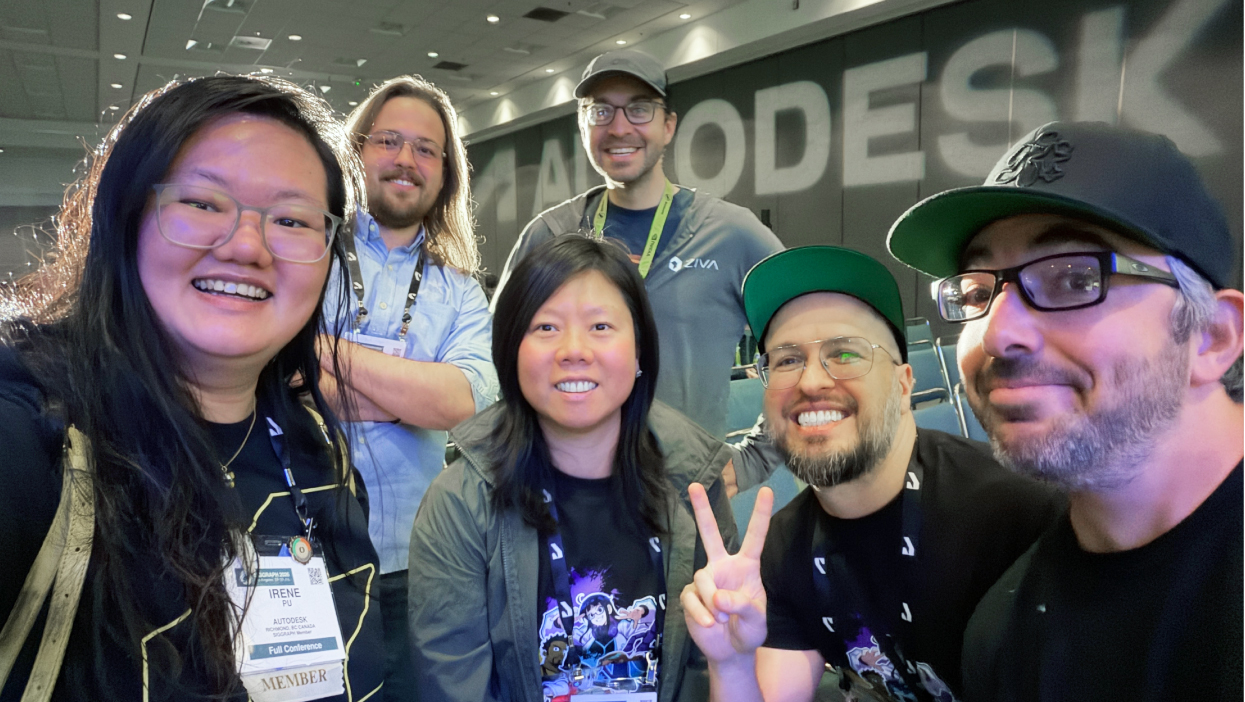
Unsurprisingly, AI was at the center of many of the talks and conversations I attended. What stood out to me, though, is that despite the speed at which the technology is evolving, there is still a long way to go before it fully meets the needs of artists and production workflows. Through many different discussions, the same ideas kept coming back: artists need control, flexibility, fast iteration, and consistently high-quality results.
There is still a gap between creative intent and the technical inputs required by AI models. Translating an artistic note into the right parameters or model instructions requires a new combination of skills: both strong traditional production knowledge and hands-on AI experience.
Tools need to provide the granular control and iterative workflow that VFX artists expect, while pipelines themselves need to remain flexible enough to evolve alongside rapidly changing AI models.
Another recurring topic was the importance of fast prototyping. Being able to quickly create visual results can help teams align around a common vision much earlier and potentially reduce some of the multiple layers of approval traditionally required. Discussions around rig portability, control rigs, and the desire for a more standardized rig representation through USD showed how important interoperability and common representations are becoming.
The Hidden Issue of AI is Data
Larasika Nadela, Machine Learning Developer
What stood out for me was how little the talks focused on data. It was clearly behind much of the works I saw, but it was usually just treated as an input rather than a topic in itself. The Disney Research talk (A Generative Motion Rig for Artist-Driven Motion Authoring) mentioned they trained on about 40hours of mocap data, after someone asked about it during the Q&A. I would have liked to hear more about how data is collected, organized, and cleaned, because that feels like an increasingly important part of building these systems.
The Wizard of Oz talk was a great example for unexpected use of new technology. It stood out for how Generative AI (GenAI) was used without dismissing the artistry of the original film at all. AI was used just as another tool for expanding the shots, generating performances, and improving the resolution. I also appreciated how they openly talked about the pipeline. They mentioned the term “pipelining” to describe how it is not something they solved once, but a constant process of testing and adapting with technology and AI models moving so quickly.
And of course I’m not forgetting StoryArc. This was another highlight – spending several hours a day for three days at the booth demoing M&E Research’s prototype. Meeting people from different parts of the industry and seeing their reactions to the prototype was so valuable. Some were immediately excited by its potential, while others were still a bit skeptical about GenAI or where creative control should sit. To me, those skeptical reactions were just as interesting, because they sometimes surfaced new questions, perspectives, and concerns.
What was most valuable was comparing perspectives with people outside my usual circle. For the next SIGGRAPH, I hope the program makes more room for the less visible side of technical work, like how data is gathered, shaped, and kept useful throughout production.
Absorbing the state of the art and the community that builds it
Jenmy Zhang, Senior Principal Research Scientist
SIGGRAPH offered me a chance to experience a community quite different from the ones I had encountered at past conferences.
One of my strongest impressions was how deliberately SIGGRAPH is designed to encourage conversations. There was a genuine curiosity about how others approach their problems, and a strong desire to keep artists and end users close to research and tool development. I found that openness particularly inspiring.
My work in M&E Research focuses on physics-based character motion, and I am also part of our newly formed physics-informed AI team, where we are interested in closing the gap between digital and physical reality. I was therefore especially curious about how physics, and increasingly machine learning, can support artistic creation. Some of my favorite sessions were production sessions and invited talks that explored this from different parts of the production workflow. I was impressed by the water simulation for Avatar: Fire and Ash, where the results were so convincing that I initially forgot the water I was watching was simulated rather than filmed. I was equally fascinated by the work behind Varang’s facial performance, where biomechanically plausible modeling helped translate an actor’s expressions to a digital character, and by Framestore’s Anatomy Toolkit for realistic muscle and tissue deformation.
Across the talks I attended, what stood out to me was a shared pursuit of believability: using our understanding of the physical world to make digital characters and environments feel real, without being constrained to reproduce reality exactly. This made me think about an exciting role for physics simulation and physics-informed AI: giving artists tools to imitate any reality, with the consistency and richness we intuitively recognize from the physical world and the freedom to reshape it according to their artistic vision. I am excited to see this intersection of physical plausibility and artistic control explored even further in the future, and I hope to come back with a submission of my own.
Virtual Production – the Transformative…and Overshadowed…Craft
Luke Melovich, Behavior Modeling Researcher
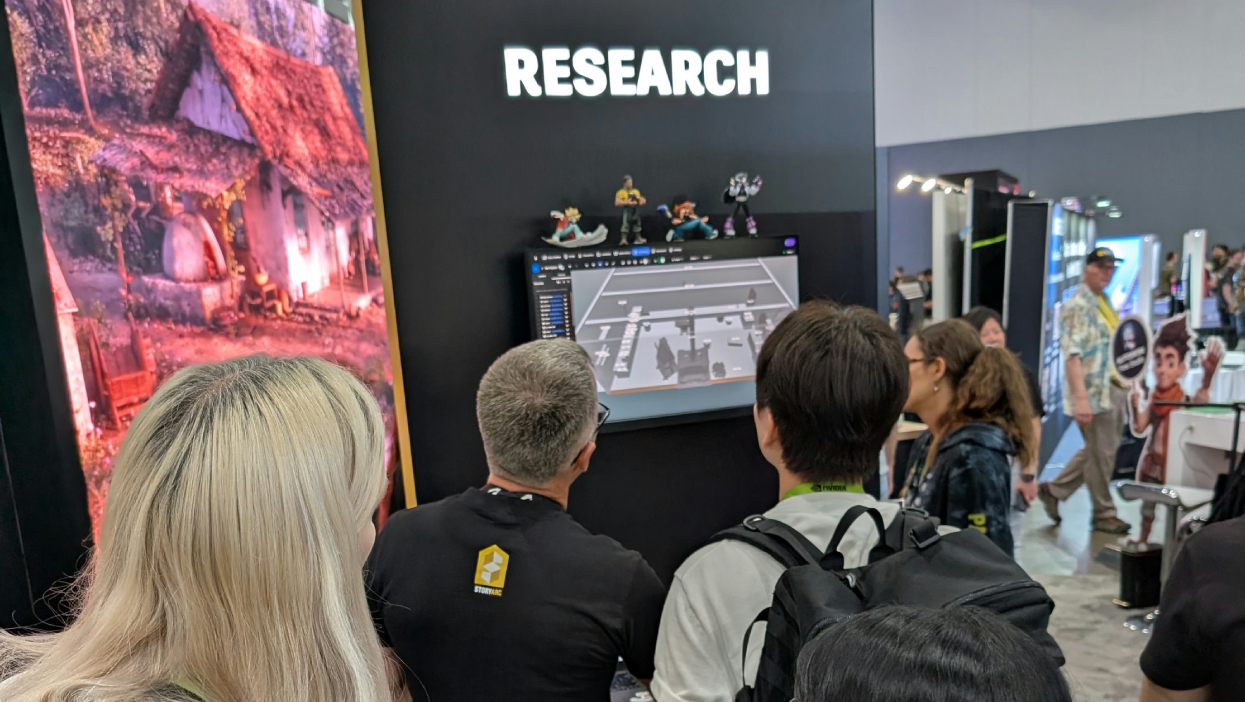
The talks from real productions at SIGGRAPH 2026 has made it clearer to me that artists value workflows that maximize iteration and minimize the period of creative feedback loops.
Artists want to try out their ideas quickly (and correctly) and judge them just as fast so they can move on. In an industry known for tough deadlines and heavy demands, this preference often becomes a necessity. AI is the flashy solution that is often thrown around for various forms of this problem. SIGGRAPH 2026 was far and away no stranger to this, and undoubtfully there is tremendous value that AI unlocks. But I fear that some of the most impactful evolutions in production have been overshadowed – most strikingly to me, the expanding role of real-time virtual production since its modern inception over a decade ago.
Real-time virtual production techniques allowed the directors of the “Lost Bus” to step into the real sets virtually, well before actual construction, and work through the movie scene-by-scene. The ship itself could be re-designed as needed to fit the shots, the alien’s behavior/movement could be blocked out, yet most importantly was what it enabled— creativity that is discovered, not manufactured. I was inspired by this when I learned the most striking and memorable shots in the movie were not planned, they were discovered. For example, one shot of the protagonist space-walking, with a strikingly long shadow of his silhouette casted onto the body of his vessel explicitly mentioned in the talk as framing discovered through play with lighting and camera angles on the virtual set.
The studio behind this talk detailed how they built a digital twin of the real filming location that was used for both shot-planning and many actual final shots. With a one-to-one replica of the location, they could plan bus routes, on-set bluescreen placement, shot-framing, and even the exact traffic itself. The most memorable part of this talk was that, to create realistic traffic, they took advantage of the interactive real-time aspects of the digital twin and ‘drove’ virtual cars on the road (like a game). There was no path keyframing and no hand-animation of the cars at all- just a vehicle system designed for gameplay, using input recorded from artists driving these virtual cars on the virtual roads.
The most valuable tools for accelerating workflows do not just lessen work, they lessen the technical burden of work and enhance an artist’s ability to experiment creatively. This is a lesson I will hold close in my own work, and next year at SIGGRAPH I hope to see more even more of the industry following suit.
Valuable Research is Still Needed to Stay Relevant
Derek Cheung, Principal Machine Learning Engineer
I spent most of my time tagging along with Product Managers from IME talking with customers in closed door meetings where we talked about Maya’s Character FX roadmap and our new image-to-groom model prototype.
The session that stood out most for me was the BOF on the state of hair in the industry. Hearing various studios share the problems they were currently facing in an open forum was useful, especially paired with the notable lack of research around all of their challenges.
One trend that stood out was the widespread adoption of Houdini. Its procedural and flexible nature makes it appealing to studios, and the availability of experienced users is a significant factor. On a positive note, many studios expressed that they prioritized using the best tool at hand, and were open to switching between DCCs. They also expressed a preference for staying in Maya so that their character department could work on grooms. Currently if it moves to Houdini then the effects department takes over hair.
Our image-to-groom work project received a strong reaction in closed door meetings. Feedback was very positive, with studios saying the prototype was impressive and already looked usable for background characters. For hero characters, it was clear that driving accuracy was the next focus. Our approach of focusing on guide curves first, along with the modifier stack, was well received and validated our thinking.
See you next year!
SIGGRAPH remains the place where veterans and first-timers alike can immerse ourselves in real conversations about real M&E problems. AI has found its place as a topic of conversation, and SIGGRAPH 2026 further confirmed that control is at the center. Autodesk has a meaningful role to play in choosing the right scope in its AI models that fit the future workflows and the data products required to support it. Validation of M&E Research work this year is inspiring everyone to do better, accelerate, and give artists powerful tools they need to create at the right speed for them. We’re excited to see what next year brings, and to share more of our research work.
Get in touch
Have we piqued your interest? Get in touch if you’d like to learn more about Autodesk Research, our projects, people, and potential collaboration opportunities
Contact us