From Conversation to Transformation: Strategic Foresight in Action
The most impactful professional relationships don’t begin with a formal pitch; they start with a conversation. This was exactly the case with Beca, one of Asia Pacific’s largest independent advisory, design and engineering consultancies, and their journey into Strategic Foresight with Autodesk Research.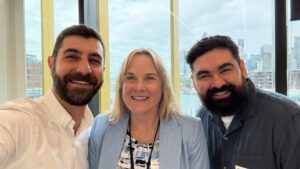
The engagement began last year at Autodesk University, where Erin Bradner, Director of Strategic Foresight at Autodesk Research, met Thomas Hyde, Chief Transformation and Innovation Officer at Beca. As a company with over a century of experience, Beca has faced and flourished through many shifting environmental and technical impacts in the past. Thomas and Erin asked themselves: What if a structured exploration into signals of change could help shape and refine Beca’s future?
Designing an Experiment
Rather than approaching this as a traditional services engagement, Erin and Francis Gonzales from the Strategic Foresight team, framed it as an experiment. They created a lightweight presentation designed to provoke and spur conversation. It explored how the team could take Autodesk’s internal Forces of Change report – an annual report that examines the known drivers of change reshaping the world, the uncertainties that could meaningfully alter strategic conditions, and the risks and opportunities that emerge from their interaction – and apply it externally. Would it resonate? Could it create the same kind of value for Beca that it does for Autodesk?
Two Methods, One Goal: Expanding Strategic Thinking
The in-person workshop took place in January at Beca’s Auckland office and included most of Beca’s senior leadership team and two members of Autodesk’s Strategic Foresight team. It centered on two activities:
1. Forces of Change (Visualizing Intelligence)
The Foresight team modified the full, internal Forces of Change report, creating a simplified, accessible format for the session with Beca. A large visual poster, paired with voting stickers, turned the session into a dynamic, participatory experience. Leaders moved around the room, debated signals, and collectively prioritized the forces shaping Beca’s future. Erin calls this voting activity, and the lively discussion that it provokes, “surfacing and visualizing the collective intelligence in the room.”
2. Value Network Analysis (A New Frontier)
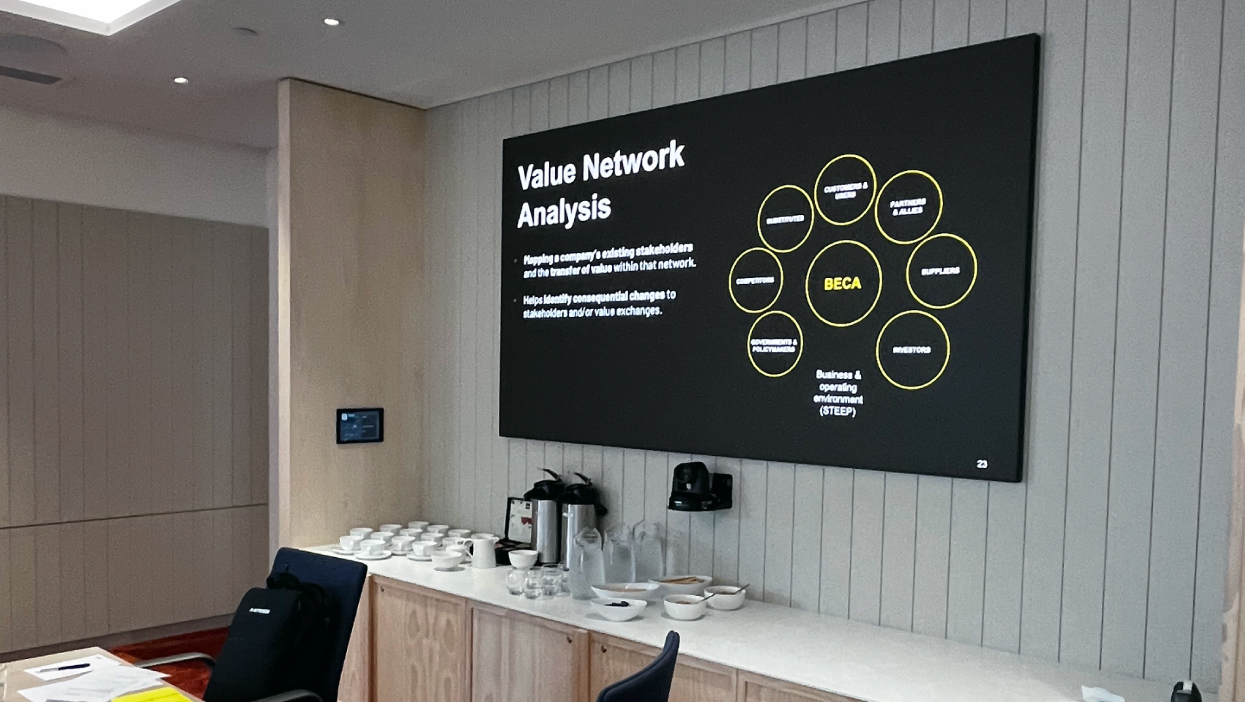
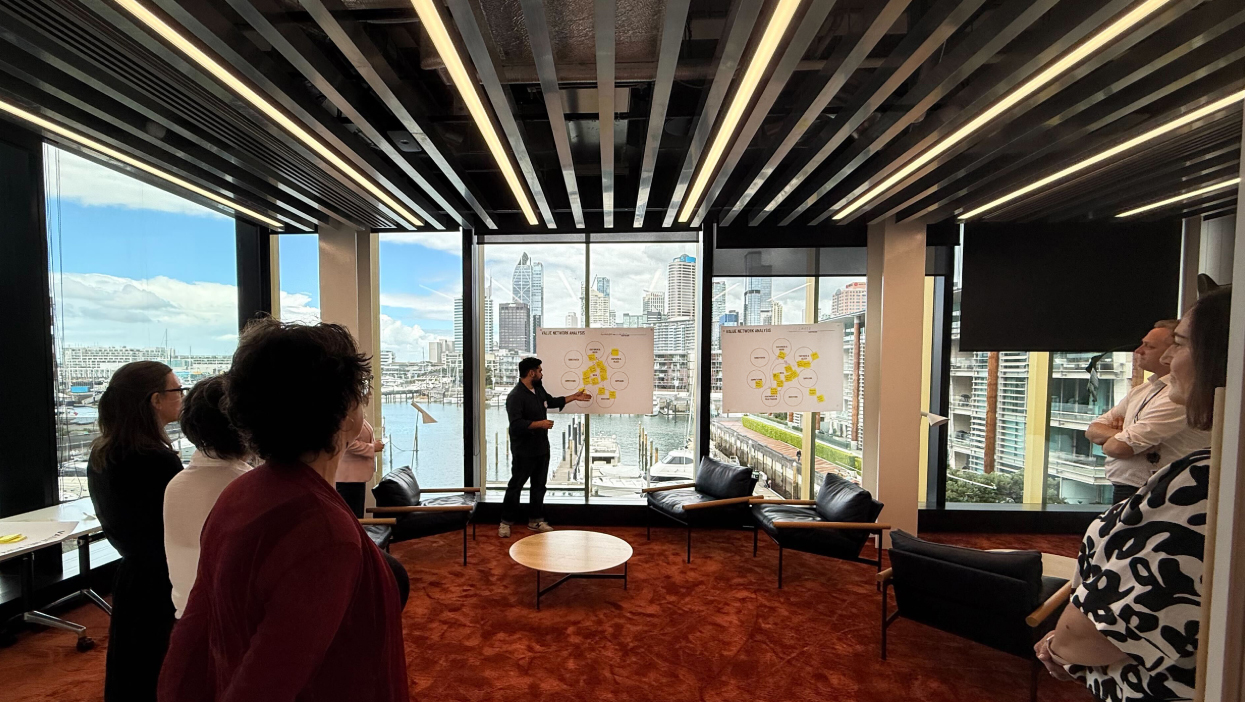
The second method was something entirely new for external delivery: Value Network Analysis. Working closely with Thomas ahead of time, the team developed a business disruption scenario focused on AI and workforce upskilling. This grounded the exercise in a real challenge that was immediately relevant to Beca. During the session, leaders first explored the upskilling example together. Then, in smaller groups, they built their own value networks, mapping out how a different business disruption could impact their ecosystem. Erin has nicknamed this exercise the “disruption decoder” and says its power comes from flipping each business disruption into an opportunity.
During the exercise, one participant asked: “How do I talk about something that hasn’t happened yet?” This question opened the door to a core principle of foresight: permission. Permission to explore “what if,” permission to construct informed fiction, and permission to think beyond today’s constraints.
Once that permission was granted, the energy in the room shifted. Leaders leaned in and began to think expansively about the future.
A Two-Way Learning Experience
While the workshop clearly delivered value to Beca, it was also a learning experience for Autodesk’s team. From early co-creation with Thomas to in-room facilitation, the process provided deep insight into how a forward-looking organization like Beca interprets disruption and opportunity. It reinforced that customer engagements are not one-directional, they are openings for shared discovery.
This wasn’t Erin’s first attempt to share Forces of Change and other Strategic Foresight practices externally, but it was the first time she and her team applied them at this level of depth and collaboration with an Autodesk customer. Erin says it was one of the most professionally rewarding meetings she’s run because Beca didn’t just want to ponder the future, they worked through each activity with purpose and, at the end, distilled the insights into specific strategic actions, with clear owners and next steps.
“A week after this engagement, Beca ran a great session on future risks and opportunities,” said Thomas. “We brought an overview of our work with the Foresight team, and it sparked even more conversation and considerations.”
Several factors made the difference:
– Executive sponsorship at Beca, including active CEO participation
– Perfect timing, aligned with Beca’s own strategic planning schedule
– In-person facilitation, enabling energy, trust, and engagement
– A real use case, grounded in AI and reskilling
– A willingness to experiment, on both sides
Looking Ahead
For Beca, this engagement reinforced their commitment to shaping the future, not simply reacting to it. As a century-old firm, they are actively invested in exploring and understanding what comes next, for their business and their region.
For Autodesk’s Strategic Foresight team, it marked a milestone: successfully bringing Forces of Change and other Foresight tools to a customer in a way that drives tangible outcomes.
And it all started with a conversation.
Get in touch
Have we piqued your interest? Get in touch if you’d like to learn more about Autodesk Research, our projects, people, and potential collaboration opportunities
Contact us