From Generative AI to Future Impact: What SXSW Revealed
The future of AI remains a dominant conversation in the tech world and beyond, with people discussing its merits and debating its potential drawbacks. Karl Willis, Head of Model Delivery, and Natalia Vasquez, Senior Strategic Foresight Specialist, at Autodesk Research attended SXSW last month and participated in panels regarding the future and current state of AI. Both shared their thoughts on AI’s transformative potential in design and engineering, as well as the societal, ethical, and practical tensions around AI.
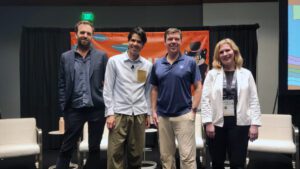
Karl participated in a panel, “Building Reality: Generative AI for the Physical World,” exploring how AI can be used to generate designs for things that can be built, manufactured, or constructed, spanning products, machines, buildings, and infrastructure. Joined onstage by Caitlin Mueller (MIT), Ryan McClelland (NASA), and moderator Duann Scott (CDFAM), the group discussed the transformative role Generative AI has played around text and images while looking ahead to its potential in the physical world.
“Generating a full building with AI is far more complex than generating an image or a paragraph,” said Karl. “Behind the walls there’s electricity, HVAC, plumbing; all these hidden dimensions that are there that I think we will eventually tackle.”
Getting there requires data that captures design intent as well as geometry, deep domain understanding, and models capable of handling a level of complexity far beyond what we have today. This evolution also pushes engineers toward systems thinking, where the focus shifts from “how” something is built to “why” it exists, enabling faster, more integrated workflows.
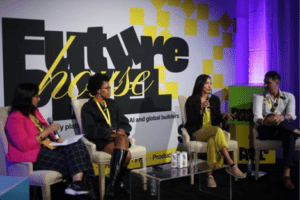
Generative AI is also bringing performance and sustainability into the design process from the start, turning factors like cost, efficiency, and environmental impact into inputs rather than afterthoughts. This dovetails with the focus of Natalia’s conversation at FuturePIXEL House, an official SXSW venue that explored how intelligence becomes playable and culture evolves after AI. The conversation, “Who Decides What AI Becomes?” delved into AI’s risks and potential, highlighting questions around pathways towards general intelligence, workforce disruption, and environmental impact beyond energy into applied use.
Panelists also explored both the promise and complexity of AI’s rapid evolution, along with the investments that are pushing beyond language into world modeling. While opinions differed on whether AI can truly be aligned with human values, there was agreement that defining those values and the future we collectively want to build towards is critical, as is designing for human input. Similar to NASA’s Ryan McClelland, who presented onstage with Karl and said that working with generative AI can feel like “collaborating with an alien,” human judgement and input will drive and guide the success of AI.
Another key takeaway from Natalia’s session is that public perception has shifted from viewing AI as incremental to transformative, raising urgent questions about the future of work, what AI could unleash for creativity, and what wicked problems industry and humanity wants to point this emergent capability at. Novel imagination, clear intent, and the adaptability to convey it in new ways may be the most critical skills in preparing for an uncertain but powerful AI-driven future.
AI’s power is real but incomplete, and its trajectory depends on human guidance. In the industries Autodesk serves this plays out in concrete ways. Karl noted that directing AI is still a skill: working with these tools requires the ability to clearly describe goals, define constraints, and bring judgement to the results. As he put it, “prompting is a skill worth investing in.” The tool lowers the floor; expertise still raises the ceiling.
For the customers who use Autodesk products every day, the near-term opportunity is not replacement but acceleration. AI can automate the tedious, surface options that would take weeks to explore manually, and connect performance data, sustainability targets, and cost constraints to the earliest stages of design. The future of work in these industries will hinge on how well practitioners can collaborate with these systems, shaping them toward outcomes that are not only faster and more efficient, but also more sustainable and aligned with the complexity of the physical world.
Get in touch
Have we piqued your interest? Get in touch if you’d like to learn more about Autodesk Research, our projects, people, and potential collaboration opportunities
Contact us