From Rigid to Responsive: The Sensors Redefining Manufacturing Intelligence
I recently participated in a course series focused on electronics. The signals I gathered are presented in this post and explore how novel sensing may shape the future of the manufacturing industry. Flexible and stretchable electronics mark a radical break from the rigid silicon era. These devices can be self-powered, form-factor-free, intelligent systems that transcend the limitations of conventional rigid, silicon-based electronics. From conformal and wearable, to implantable, transient and interactive systems, this new frontier merges materials, sensing, and intelligence in ways that could reshape digital twins and the future of work.
The Shift from Rigid to Freeform Electronics
Signal: Freeform electronics require a new design logic, one where intelligence becomes adaptive, embedded, and perceptive.
For decades, the electronics industry has been defined by the remarkable success of conventional Complementary Metal-Oxide-Semiconductor (CMOS) technology and Moore’s Law. However, the physics and economics of this model are nearing their limits: quantum effects disrupt miniaturization, fabrication costs rise sharply as dimensions approach atomic scales, and performance gains are slowly plateauing.
The next wave of progress won’t come from just making chips smaller, it will come from new materials, new architectures, and new kinds of integration strategies, supercharged by AI. This emerging concept of flexible and stretchable electronics conforms, bends, and interacts with the soft, dynamic world.
Flexible & Stretchable
Signal: Flexible electronics mark a shift from assembled components to embedded functionality, with novel heterogenous integration and material composition core to their adoption/accessibility.
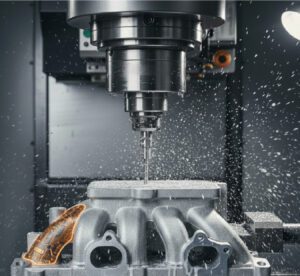
A flexible and conformal interial measurement unit tracks the position and rigidity of an automotive part during manufacturing.
The flexible class of electronics behave like materials and enable intelligence to be woven into surfaces, masses, or structures. Fundamentally these devices are governed by physics, their manufacturability is limited by the intrinsic mechanical properties that dictate how individual materials respond to stress: Brittle materials like ceramics fail by crack propagation, while polymers absorb energy through deformation due to weaker intermolecular forces.
To build a flexible device, every component (from the transistors and sensing components to the conductive pathways connecting them) must be able to bend. This requires an advanced toolbox of materials that are: Thin, lightweight, portable and novelly integrated.
Integration of layers must be purposely architected based on end-use function, balancing mechanical, electrical or material performance to avoid issues like delamination, barrier integrity, fatigue failure, layer adhesion, thermal management or mechanical hysteresis.
Amplifying the Intelligence Layer
Signal: Flexible electronics give rise to sensory digital twins, transforming them into pervasive and perceptive systems with an extended sensory reach capable of adapting to their own physical state.
By embedding sensors directly into materials, machines, and environments, digital twins gain continuous awareness of the physical world. This allows them to model, predict, and respond to change with precision, thereby extending their reach across every surface and structure. Each component becomes a live data source, tracking strain, heat, motion, noise, pressure, stress and more in real-time.
At the heart of this challenge is heterogeneous integration, or the fusion of diverse functional elements, sensing, computation, power, circuitry, power sources, and communication into a compliant platform. As sensors shrink, rigid interface electronics remain a bottleneck. Emerging solutions using programmable system-on-chips and compact transceivers integrate amplification, data handling, and energy management into flexible footprints, allowing intelligence to reside directly at the point of measurement.
Achieving this amplification in the intelligence layer of digital twin architecture demands a deep understanding of the bottlenecks shaping flexible electronics today. Realizing their full potential requires deliberate choices in material engineering and system design to balance flexibility, reliability, and integration. Examples include flexible mono-crystalline semiconductors that bring logic and RF functions closer to data sources, thin-film transistors that operate at low processing temperatures, and advanced 1D/2D materials (nanowires, carbon nanotubes, graphene, transition metal dichalcogenides) with exceptional electrical, mechanical, and optical properties. Trade-offs between mechanical, electrical and environmental contexts will occur. These include:
- Sensor integration & material selection – Material choice and engineering are critical for reliable components that can endure demanding fabrication and operating conditions. The pursuit of flexibility expands options beyond rigid silicon, each with distinct advantages and constraints. Integration and miniaturization remain limited by bulky interface circuitry and constrained power systems, driving the need for flexible, integrated energy harvesting and storage solutions.
- Reliability in performance monitoring – The ability to bend and stretch defines flexible electronics but also challenges their longevity. Mechanical strain alters physical dimensions and crystal structure, shifting key parameters such as carrier mobility, threshold voltage, and leakage currents. Ensuring long-term consistency requires accelerated lifetime testing to predict dielectric and component degradation under deformation, and careful measurement of devices in their bent state, not merely after re-flattening. Understanding process-induced variation and stress effects is essential for maintaining data integrity in digital twins.
- Energy management for autonomy – For flexible devices to operate independently, they must generate and store their own power. Energy harvesting through photovoltaics, thermoelectric, or piezoelectric reduces battery reliance and wiring complexity. Flexible batteries and supercapacitors buffer this harvested energy, enabling self-powered sensors, but these added considerations add complexity to integration strategies.
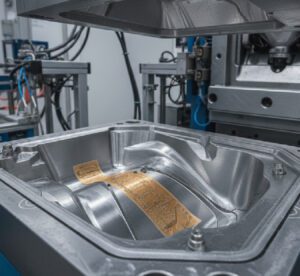
A transient, dissolvable electronic device provides short-term diagnostics of an injection molding cavity, monitoring temperature and humidity ingress during the critical stage of mold prototyping/development.
Novel ECAD & Simulation
Signal: Flexibility changes the way we model, validate, and iterate designs. Mechanical, electronic, and data modeling within the digital twin environment will require tools that simulate physical deformation and digital data fidelity. While a digital twin acts as living testbed for validating design intent against real-world behavior, the next competitive edge in manufacturing is design feedback speed, not just prototyping speed.
The design of flexible systems must move beyond component-level assembly toward architected intelligence, where mechanical stability and electrical performance are co-optimized from the outset. Achieving this demands new design workflows that unite mechanical, materials, and electronic disciplines within a shared modeling framework.
This next-generation framework requires a stronger interplay between mechanical-electronic design. Traditional CAD or ECAD environments must evolve to simulate not only electrical performance but also strain, flexure, and material deformation. Due to the underlying physics of flexibility, structural geometry becomes as important as electrical layout. Techniques such as fractal routing, serpentine interconnects, and corrugated geometries enable circuits to bend and stretch without failure, giving the form-factor influence on reliability.
In this paradigm, design becomes the foundation of resilience, autonomy, and fidelity. By embedding mechanical adaptability within sensor architectures, flexible electronics can deliver accurate, uninterrupted data to digital twins, even in dynamic, harsh and high-deformation environments.
Applications
Signal: The ability for flexible devices to conform to complex geometries, detect subtlety, be transient, and interact with mechanical or human environments enables physical compliance and unlocks entirely new categories of sensing.

Under his mask, a welder wears a conformal smart-skin that detects prolonged exposure to hazards (ultraviolet, infrared light, and noxious gases) emitted through welding arcs.
Ultra-thin sensors enable high-fidelity continuous rich multidimensional data closer to the point of operation. These devices enable closed-loop, adaptive data collection, analysis, and action to occur as a single, fluid process. In this configuration, flexible electronics serve as both the input and the output that allows digital twins to interpret deviations, recalibrate processes, or prevent faults before they occur. The possible deployment opportunities are endless:
- Conformal & Embedded Sensing – Integrated directly into machines, molds, or tools provide continuous structural, thermal, and mechanical data
- Acoustic & Tactile Feedback – Sensors capable of detecting vibration, resonance, and contact patterns create new channels for improving processes, safety, or machine-to-machine and human interactions.
- Adaptive & Closed-Loop Systems – Flexible sensors can autonomously fine-tune operations, balancing quality, energy efficiency, and throughput in real time.
- Transient Monitoring Networks – Engineered with programmable lifespans or recyclable arrays, transient electronics are designed to enable temporary instrumentation of a prototype, production run, or maintenance cycle, then dissolve, or reconfigure after use.
- Physiological Monitoring – On body devices extend awareness into biological systems, tracking vital signs, muscle activity, posture or neural signals for real-time modeling and intervention.
- Multifunctionality – Sensors can be designed with additional layers, with each one creating added functionality (e.g. strain, pressure, humidity, temperature, flow, pH, and proximity etc.) or material potential within the same integrated system.
- E-Textiles & Smart Clothing – Embed sensors directly into fabrics, allowing for continuous, non-intrusive monitoring of human activity or environmental conditions. This is significant for monitoring worker performance, safety, or the condition of products as they are handled or worn.
Conclusion
The next industrial IoT revolution will emerge not from new materials alone, but from the fusion of sensing, fabrication, and intelligence into a continuous design–make–operate loop. Flexible electronics stand at the center of this transformation, a signal technology that physically enables digital twins to sense, interpret, and adapt in real time. They will unlock the future of work and worker safety, creating responsive environments where machines and humans collaborate seamlessly. Their applications are boundless, limited only by our creativity and the imagination with which we bring to shaping this next era of intelligent making. Realizing this vision, however, demands overcoming persistent challenges in flexible electronic manufacturing, integration, long-term reliability, and scalability/costs, a task well suited for design-to-make software.
Get in touch
Have we piqued your interest? Get in touch if you’d like to learn more about Autodesk Research, our projects, people, and potential collaboration opportunities
Contact us