Designing Beyond the Keyboard, Mouse, and Screen
Autodesk Research is exploring how AI, spatial computing, and connected data could create more intuitive ways to interact with design tools and project knowledge
What if the tools we use to design and make could understand not only what we’re working on, but why, and adapt to how we want to work?
Autodesk Research is exploring a future where AI, intelligent agents, connected data, and spatial computing could help teams work more naturally and collaboratively while preserving project context from one interaction to the next. At AU 2026, we’re putting that vision into practice through a real-world customer use case designed to explore and validate experimental AI workflows for sustainability.
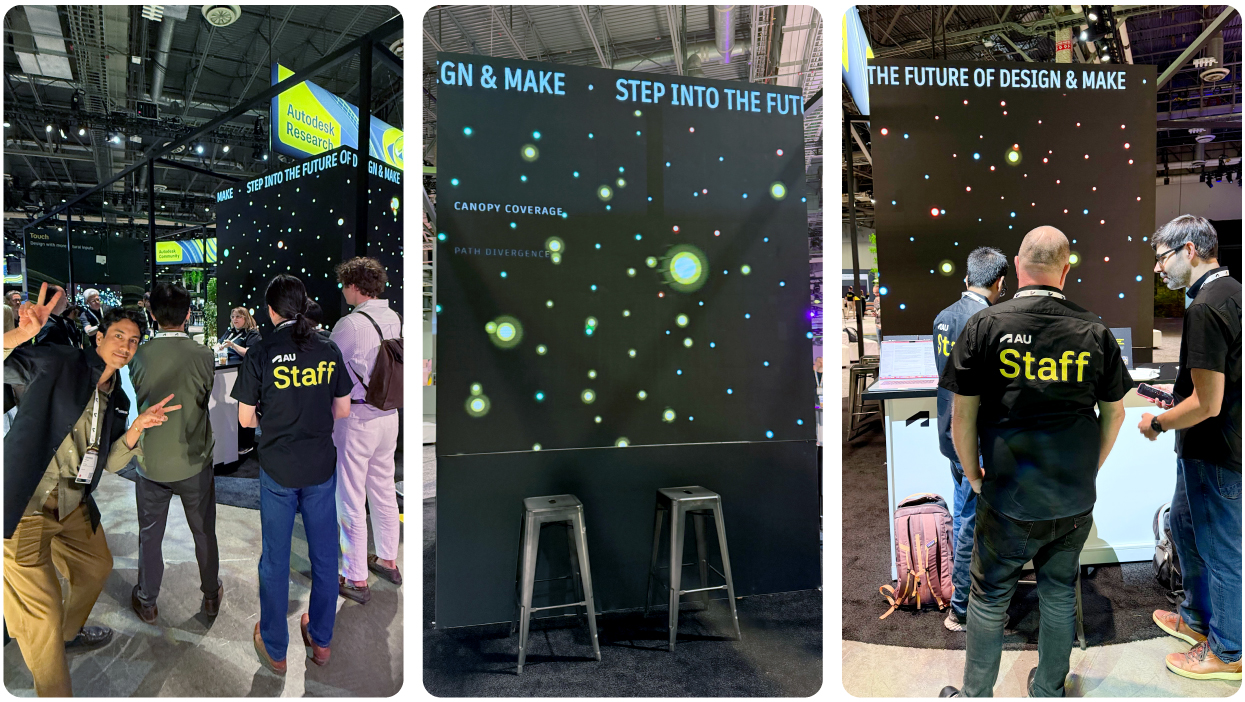
Through three interactive experiences on the AU expo floor – Touch, See, and Speak – the team is examining how AI could reshape the way people engage with their tools, data, and one another across the Design & Make process – and making this in-progress research available for Autodesk customers to test and experience firsthand.
The Use Case: Site Design for a Public Park
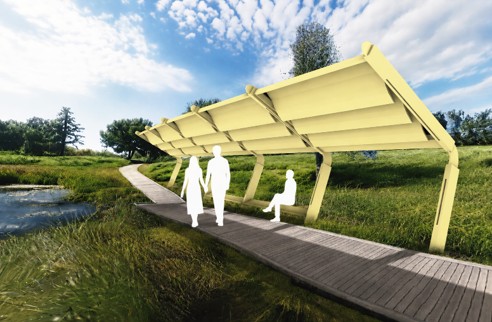
To ground these experiments in a real-world design challenge, Autodesk Research is applying them to the site design of a public park with sports facilities in a hot climate. The use case focuses on pedestrian pathways and shade structures, where design decisions involve tradeoffs across carbon, cost, shade, and biodiversity. Through the Touch, See, and Speak experiences, participants can explore how AI and project data could help teams understand these tradeoffs, evaluate alternatives, and make more informed design decisions.
Touch: Make digital design more tangible
Designers often reach for physical models, sketches, and materials because they’re intuitive ways to explore ideas. But moving those ideas into a digital workflow usually means returning to a keyboard, mouse, and screen.
The Touch experiment explores what happens when those worlds come together.
Imagine a team gathered around a site plan, moving physical models to test different layouts while an intelligent system responds in real time. For the public park example, that could mean physically moving buildings, paths, and shade structures around a projected site model and seeing the digital design respond in real time, allowing designers to explore how each change could impact shade, carbon, cost, and biodiversity. The experiment examines whether this kind of interaction could make working with a digital design feel more like the way people naturally create and collaborate.
See: Bring the whole project into view
A project rarely lives in one place. Its context is distributed across design files, requirements, meeting notes, stakeholder feedback, standards, and countless decisions made over time.
The See experiment explores how AI could connect that information into a shared source of project knowledge.
Rather than searching across tools to reconstruct what happened, future industry teams could see relevant information and competing requirements together. For the public park, that could mean viewing the site model alongside project requirements and supporting documents, helping designers see where requirements apply, identify potential conflicts, and explore design responses in context. Over time, this kind of connected project knowledge could also give teams a clearer view of both what was decided and why.
Speak: Collaborate naturally with people and AI
What if interacting with a complex project could be as natural as having a conversation?
The Speak experiment explores how natural language, AI agents, and immersive environments could bring design, analysis, and collaboration together.
For the public park, that could mean moving through the site while asking questions about the design, calling up analyses like airflow or structural performance, and comparing options for shade structures based on a variety of factors, all through natural conversation and without switching between applications and modes of work. The experiment explores how AI could become part of the design conversation itself, helping teams interact with complex project information in a more natural way.
One connected Design & Make experience
The Touch, See, and Speak experiments represent different interactions, but they’re built around one idea: the future of Design & Make could be a connected system that maintains project context and adapts to the people and tasks at hand.
The research we’re sharing at AU 2026 explores how people, data, and intelligent systems could work together in new ways. By making technology more tangible, context more accessible, and interaction more natural, Autodesk Research is exploring ways people could spend less time navigating their tools and more time designing and making.
Follow Autodesk Research at AU and share your thoughts on our work to help shape the future.
Get in touch
Have we piqued your interest? Get in touch if you’d like to learn more about Autodesk Research, our projects, people, and potential collaboration opportunities
Contact us