Designing at the Right Level
Why Hierarchy Matters More Than It Appears
Hierarchy in engineering is often treated as an organizational convenience: a way to manage bills of materials, drawings, ownership, and documentation. But hierarchy is more than administrative structure. It is a design logic. It shapes what counts as a meaningful requirement, what counts as a constraint, and what kind of reasoning is even appropriate in a given context.
Consider a familiar pattern. A whole-product objective might be clear and useful at the top level, but that does not mean it can be passed directly into every subsystem. Some constraints should be partitioned. Some should be translated. Some should remain upstream and only influence lower-level design indirectly. When this distinction is not handled well, teams end up with requirements that are technically precise but contextually weak.
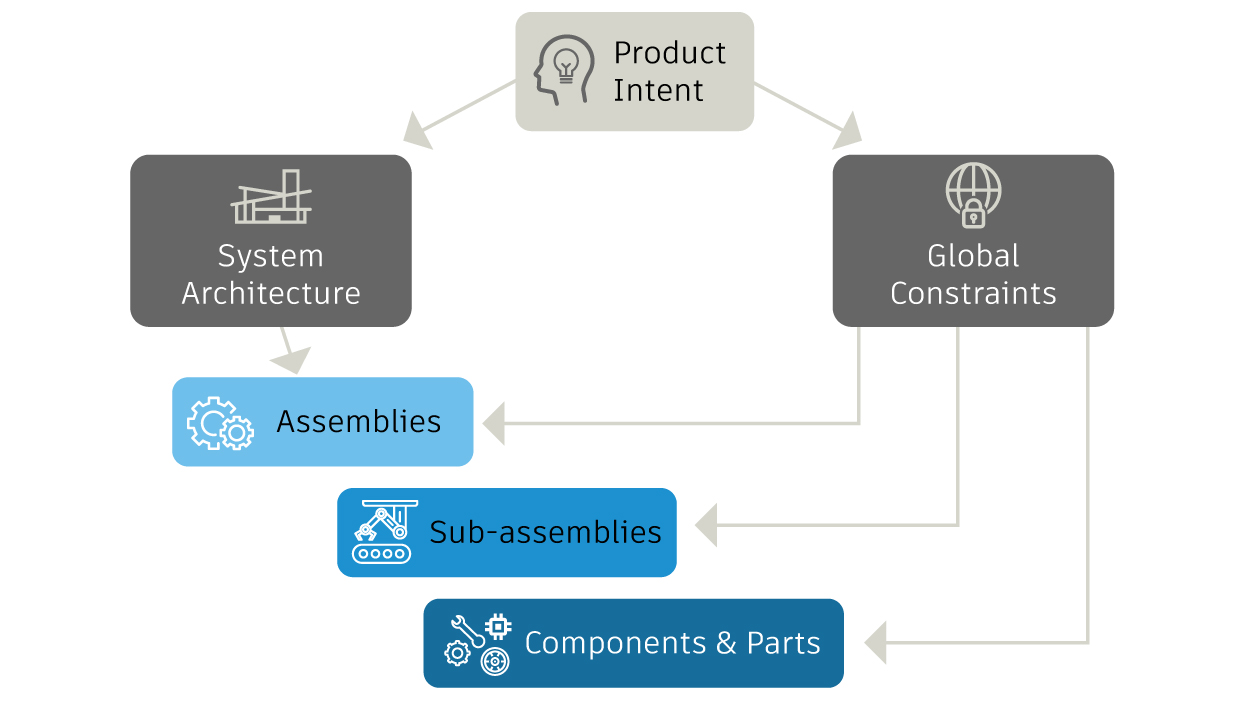
Figure 1: Engineering intent moves through system hierarchy, but it should not move unchanged. Each Layer needs reinterpretation, not simple copy-and-paste.
That weakness can be hard to detect because the language may still sound correct. A requirement can look disciplined while being mis-scoped. It can be measurable and still belong at the wrong layer of the system. This is one reason requirement review often feels harder than it should. Teams are not only checking wording. They are checking whether a statement lives at the right abstraction level.
The Cost of Getting Scope Wrong
Poor scoping creates several kinds of friction at once. The most obvious is rework. A team may spend time designing to a target that never should have been imposed at that level. But there is also a quieter cost: the erosion of clarity. When product-level and subsystem-level concerns are mixed together, the signal quality of the entire requirement set drops.
This affects downstream work in specific ways:
- design teams may optimize locally for the wrong thing,
- simulation teams may verify behavior that is not actually the right success criterion,
- manufacturing teams may inherit constraints without understanding whether they are fixed or negotiated, and
- review teams may spend energy debating wording rather than intent.
Over time, this blurring reduces confidence in the requirement set itself. Engineers begin to treat requirements less as decision anchors and more as negotiable artifacts that must constantly be interpreted. That habit is understandable, but it also reveals a structural weakness in the workflow.
Mechanical Systems Make the Problem Visible
For mechanical products, hierarchy affects far more than geometry. Structural behavior, motion quality, wear, manufacturability, accessibility, and environmental resistance all shift depending on where the analysis is anchored. What makes sense as a product promise may not make sense as a component requirement. What matters as a local design criterion may be too narrow to describe system performance.
This is why engineering decomposition is also a matter of preserving meaning across levels.
The question is not simply, “What are the parts?” The question is, “What responsibilities belong here?”
When teams get this right, requirements become more interpretable. They support local action without losing connection to the wider system. When teams get it wrong, they end up either over-constraining lower-level design or under-specifying it. Both outcomes create inefficiency, but they do so in different ways. One restricts useful exploration. The other delays necessary decisions.
What Context-Aware Workflows Should Support
As digital tools become more intelligent, their value will depend less on generic fluency and more on their ability to preserve system structure. The next useful class of engineering assistants may be the ones that support decomposition, allocation, and context-sensitive reasoning without flattening everything into one undifferentiated layer of text.
That means future workflows should help teams:
- distinguish system goals from local design responsibilities,
- understand where a constraint originates and where it becomes actionable,
- identify when a higher-level target needs reinterpretation before reuse,
- preserve traceability across layers without implying equivalence, and
- make review conversations easier by clarifying level and ownership.
Notice that none of these needs are purely linguistic, but rather structural. This is why hierarchy-aware reasoning matters. Better wording alone will not fix abstraction drift. Teams need tools that understand that a design system is layered, and that meaning changes as intent moves through those layers.
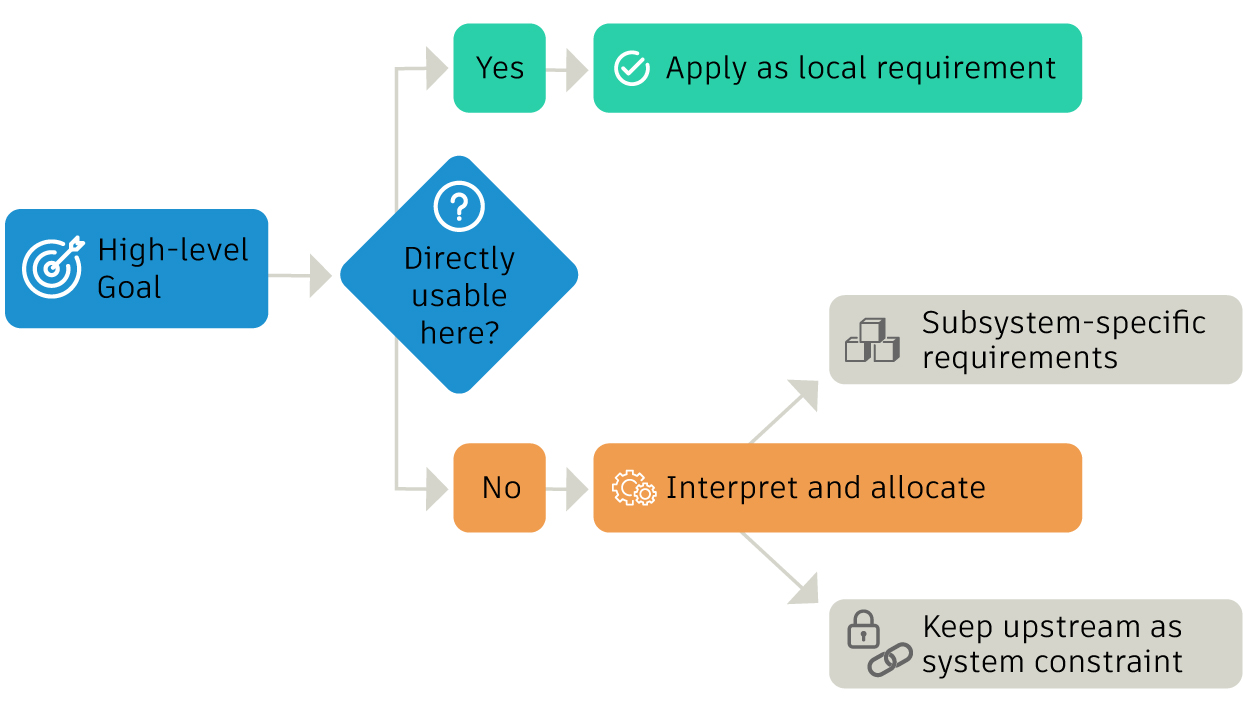
Figure 2: Better workflows do not merely pass requirements downward. They help determine whether a goal should be applied directly, adapted locally, or retained upstream.
A Shift from Static Inheritance to Intelligent Allocation
Many engineering processes still behave as though requirements are inherited. In practice, they are often allocated. That distinction is important. Inheritance implies sameness. Allocation implies interpretation.
This is one of the places where AI-supported workflows could become useful:
Not by replacing engineering judgment, but by making allocation more visible.
A useful system could help teams surface where a system-level target is likely to remain fixed, where it should be adapted, and where it may not belong at all in a lower-level requirement set. That would not eliminate judgment but rather make judgment more explicit.
There is also an organizational implication here:
Better hierarchy handling makes collaboration easier.
It helps teams across functions understand whether they are looking at global intent, local implementation criteria, or an adaptation between the two. That kind of clarity can remove a surprising amount of friction from design reviews and technical discussions.
Why Explicit Scope Improves Review Quality
A large amount of review effort is often spent untangling statements that are not exactly wrong but not clearly located.
When the level of a requirement is ambiguous, reviewers must first decode where it belongs before they can judge whether it is sound. That slows technical conversations and encourages teams to default to generalities.
Explicit scope changes that. It lets reviewers ask sharper questions. Is this a system promise or a local design criterion? Is this a shared constraint or a specific implementation target? Is the statement actionable at this level, or does it need reinterpretation? Better scoping therefore improves authorship, but also the quality of engineering dialogue around the requirement set itself.
What Comes Next
As engineering tools evolve, we should expect more workflows that recognize the difference between global targets and local responsibilities. That distinction may become foundational for design intelligence.
The most capable systems may not be the ones that simply generate the most plausible language. They may be the ones that preserve system context, reveal abstraction boundaries, and support engineers as they translate intent across levels of the product architecture.
Smarter automation is not where the real opportunity lays, rather, it is better system thinking embedded into the workflow itself.
Why It Matters
- Poor hierarchy handling leads to misapplied constraints and wasted review effort.
- Better scoping improves requirement quality before simulation or test planning begins.
- Context-aware tools can help teams preserve product intent while still supporting subsystem design.
- Clearer abstraction boundaries improve collaboration across engineering and manufacturing.
Questions to Leave With
- How often do engineering teams confuse a system-level objective with a subsystem-level requirement?
- Which constraints in a project are truly local, and which only make sense in a wider product context?
- When a requirement moves down the system hierarchy, should it be inherited, adapted, or left upstream?
- How much rework comes from poor engineering decisions, and how much comes from poor abstraction-level decisions?
- What would change if design reviews explicitly asked, “Does this statement belong at this level?”
- Could better hierarchy handling improve not only requirements quality, but also simulation, manufacturing, and cross-team communication?
- If AI is going to support engineering definition, can it understand the difference between global intent and local responsibility?
- What would a tool look like if it treated system structure as seriously as it treats language?
Get in touch
Have we piqued your interest? Get in touch if you’d like to learn more about Autodesk Research, our projects, people, and potential collaboration opportunities
Contact us