Shaping Creator-Centric AI: Autodesk Research at CHI 2026
The ACM CHI conference is the leading international conference on Human-Computer Interaction (HCI), happened recently in Barcelona, Spain. The conference brings together researchers, designers, and engineers, helping shape future directions in HCI across areas such as human-AI interaction, creativity-support tools, novel interfaces, and interactive systems for design and media creation.
This year, the Autodesk Research team had a great presence with six papers being presented on the amazing work that was done during last summer’s internships. Together they show a strong throughline in our work in exploring how novel interfaces and AI can augment creative workflows across filmmaking, virtual production, and narrative design.
Beyond Research, these works leverage and develop new technologies that are relevant to the industry broadly, including: controlling generative systems using 3D models, canvas-based interactions for generative workflows, leveraging knowledge and intent from past meetings, and generative user interfaces to enable varying levels of control and fidelity.
Taken together, these works point toward creator-facing AI that is more controllable, more contextual, and more deeply integrated into real creative workflows. Huge congrats to authors behind the work!
PlayWrite: Esen Tütüncü, Qian Zhou, Frederik Brudy, George Fitzmaurice, Fraser Anderson
Video figure • PlayWrite paper
PlayWrite is a mixed-reality storytelling system where people create narratives by manipulating virtual characters and props and improvising with AI-driven dialogue, with the system turning those interactions into structured story beats and narrative drafts. It extends our Media & Entertainment research into immersive, embodied creative tools and suggests new directions for Autodesk around human-AI collaboration in storytelling and content creation.
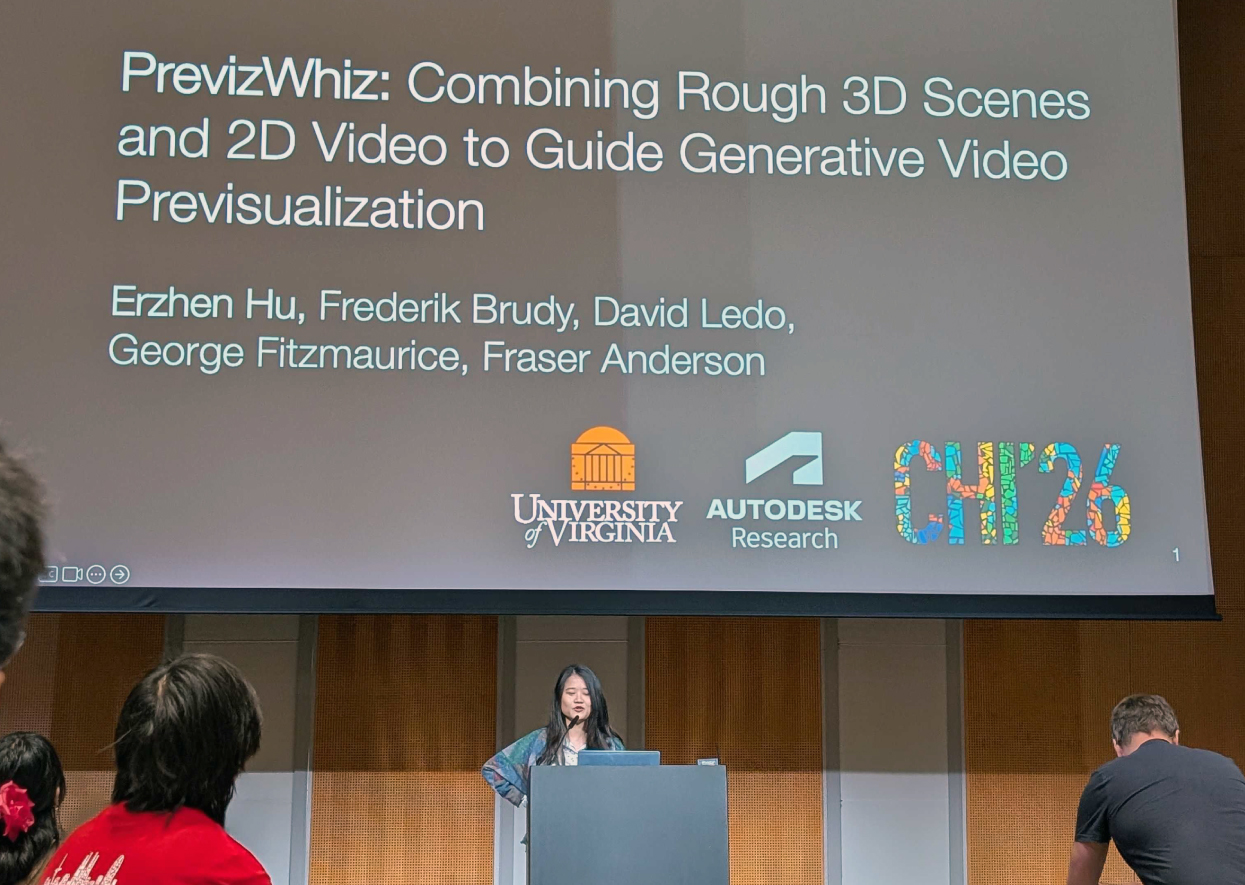
PrevizWhiz: Erzhen Hu, Frederik Brudy, David Ledo, George Fitzmaurice, Fraser Anderson
Video figure • PrevizWhiz paper
PrevizWhiz combines rough 3D scenes and 2D video clips to guide generative video previsualization, giving filmmakers faster iteration without losing the spatial and directorial control they need. This is a strong fit for Autodesk’s Media & Entertainment direction because it bridges structured 3D workflows and generative AI in a way that could make early-stage film previsualization faster and more widely accessible.
Protosampling / Atelier: Alicia Guo, David Ledo, George Fitzmaurice, Fraser Anderson
Video figure • System demonstration video • Protosampling paper
This work introduces “protosampling”, a way of understanding creative work where sampling and prototyping become tightly intertwined, and operationalizes it through Atelier, a canvas-based system for AI image and video creation. For Autodesk, it highlights an opportunity to support exploratory, multimodal, AI-assisted creator workflows with tools that preserve process, provenance, and control rather than reducing creativity to prompt entry alone.
GroundLink: Warren Park, Frederik Brudy, George Fitzmaurice, Fraser Anderson
Video figure • GroundLink paper
GroundLink explores how meeting-derived knowledge can be surfaced directly inside 3D editing workflows and tools, helping collaborators understand past decisions, constraints, and creative intent while they work. It fits Autodesk by pointing toward production tools that make collaboration, onboarding, and context-sharing much more effective in complex 3D workflows.
Lost in Translation: Kathy Cheng, Jo Vermeulen, George Fitzmaurice, Justin Matejka
Video figure • Lost in Translation paper
AI assistants are transforming creative and knowledge domains, holding similar promise for mechanical design via 3D CAD software. Yet, current AI assistance for CAD relies on geometry or command history, lacking rich design intent. The research team investigated think-aloud computing as a lightweight approach to capture designers’ spoken intent and inform how future AI assistance could leverage this to provide in-situ feedback.
PointAloud: Frederic Gmeiner, George Fitzmaurice, John Thompson, Justin Matejka
Video figure • PointAloud paper
To better support and harness Think-Aloud Computing, we introduce PointAloud, a suite of novel AI-driven pointer-centric interactions for in-the-moment verbalization encouragement, low-distraction system feedback, and contextually rich work process documentation alongside proactive AI assistance.
Get in touch
Have we piqued your interest? Get in touch if you’d like to learn more about Autodesk Research, our projects, people, and potential collaboration opportunities
Contact us