Fragmented Inputs to Design Intent
Engineering teams rarely begin with a complete, coherent requirements package. More often, they begin with fragments: a problem statement, a partial function description, a few legacy specifications, some expert assumptions, and scattered references to prior work. The challenge is not only collecting that information, but turning it into something structured enough to guide design decisions.
Requirements work is becoming an information synthesis problem, not just a documentation task. It is the engineering act of turning scattered signals into design intent.
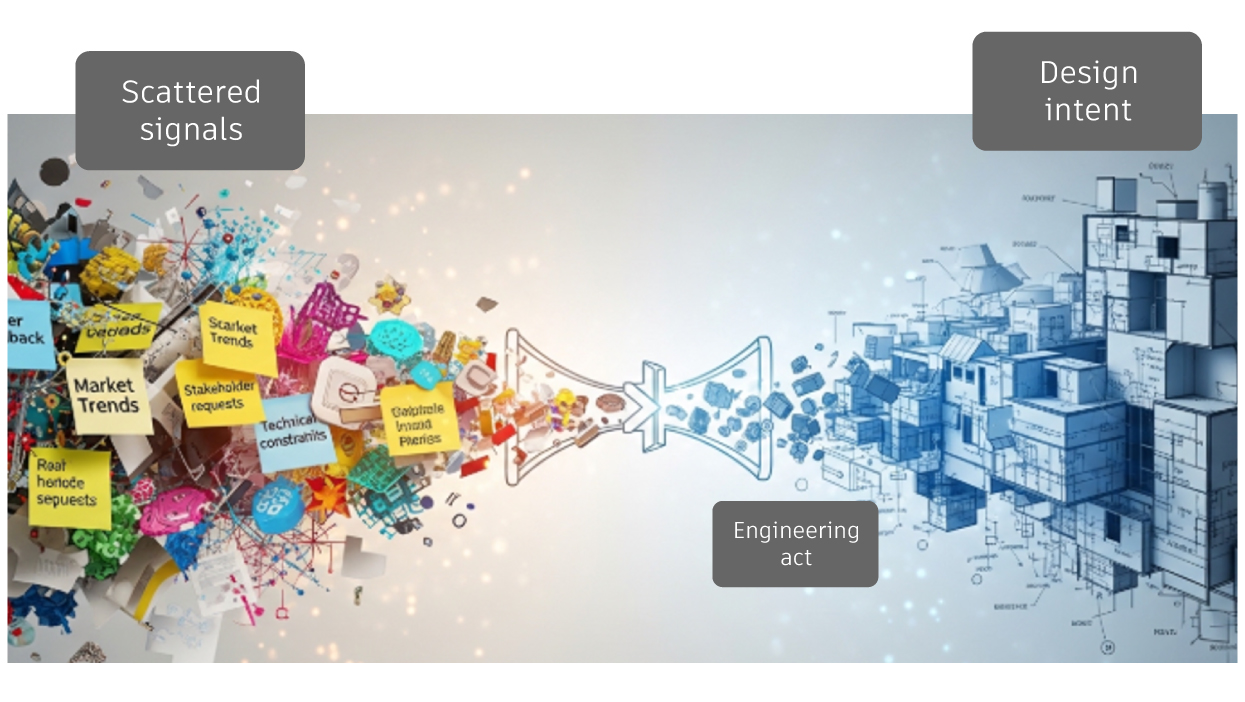
Figure 1: Requirements work is not just documentation. It is the engineering act of turning scattered signals into design intent.
As products become more interconnected and development cycles become tighter, the cost of ambiguity rises. A missing constraint discovered late can trigger redesign. A vague statement can create misalignment between design, simulation, testing, and manufacturing. A copied requirement can survive multiple reviews while still being wrong for the context where it is applied. The problem is not always that teams lack information. It is often that they lack a reliable way to consolidate, compare, and interpret the information they already have.
This is especially visible in mechanical engineering, where useful design intent sits across multiple layers at once: physical performance, interaction, safety, manufacturing, environmental exposure, service conditions, and lifecycle considerations. Each of these may be documented somewhere, but rarely in a way that is unified, comparable, and ready for action. A useful statement about force may live in a customer brief. A useful statement about durability may live in a test report. A useful statement about cleaning or material compatibility may live in an entirely different conversation. Engineers do not simply retrieve these signals. They assemble them.
That is why AI matters here in a different way than many popular narratives suggest. The opportunity is not simply faster text generation. It is better organization of incomplete evidence. It is the ability to move from narrative inputs toward clearer, more reviewable engineering intent. In that future, the most valuable tools will not be the ones that produce the most output. They will be the ones that help teams expose blind spots earlier, consolidate scattered signals more coherently, and create a stronger starting point for engineering judgment.
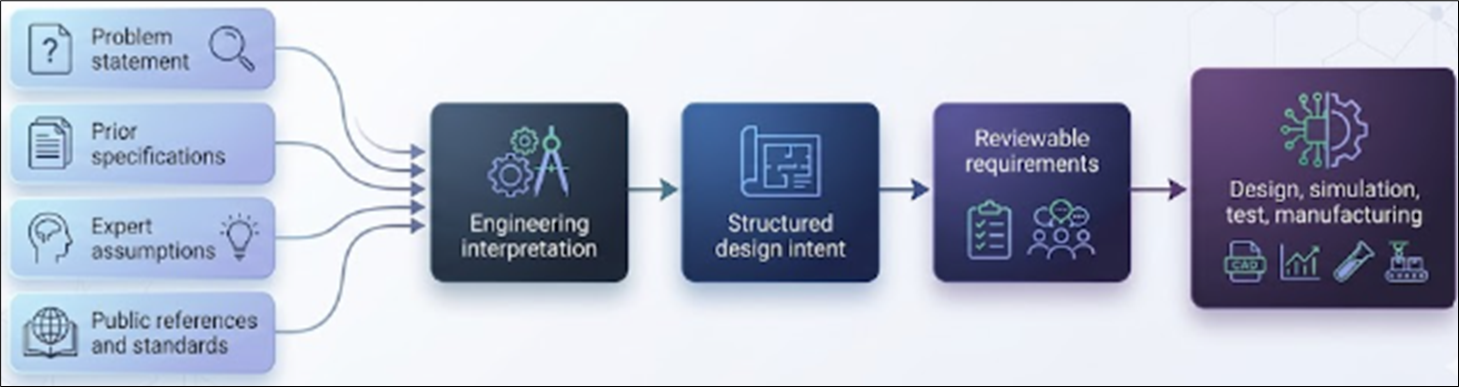
Figure 2: Modern requirement development is less a single authoring act than a convergence of multiple weak or partial signals into structured intent.
Why Fragmentation Persists
Fragmentation is not an incidental flaw in engineering work. It is a structural feature of how product development happens. Different information sources emerge at different times, for different audiences, and with different levels of confidence.
- Problem statements are narrative.
- Expert knowledge is conversational.
- Supplier data is conditional.
- Prior requirements are shaped by older contexts.
- Standards are written for broad applicability rather than one specific design moment.
Put differently:
The front end of engineering is heterogeneous by nature. The materials of decision-making are not born in the same format. They are not even born for the same purpose. Yet teams are still asked to create a coherent definition from them.
That is why so many requirement packages show one of two common failure modes:
1. The package is too thin: high-level aspirations are present, but measurable criteria are missing.
2. The package is too dense but poorly grounded: it contains many statements, but the connections between them are weak, duplicated, or unclear. Both situations slow down downstream work, because both force engineers to reconstruct reasoning that should have been visible earlier.
Why Mechanical Engineering Feels this Acutely
Mechanical products and assemblies are unusually exposed to this issue because they sit at the intersection of multiple disciplines. Requirements are rarely just about one thing. A design may need to:
- perform structurally,
- move in a controlled way,
- survive environmental exposure,
- remain manufacturable,
- support maintenance access,
- satisfy safety expectations, and
- fit within a system-level envelope.
These are overlapping constraint systems.
When these considerations are documented in isolation, the result can distort engineering priorities. Teams may over-emphasize what is easy to write down and under-emphasize what is harder to articulate early. For instance, a visible size target may get more attention than a less visible wear mechanism. A manufacturing preference may appear well defined while a serviceability issue remains implicit. The consequence is often a slow accumulation of hidden rework.
This helps explain why the best engineers often spend much of their time reframing the problem before they begin solving it. To convert fragmented inputs into a meaningful design frame.
What AI Can Actually Contribute
Much of the public conversation about AI still centers on generation: generating drafts, generating summaries, generating lists. But in engineering, generation is only part of the value. Synthesis is the larger opportunity. When used well, AI can help teams:
- identify missing categories of information before those omissions become expensive,
- translate narrative statements into clearer engineering themes,
- organize constraints into more comparable groupings,
- surface tensions between goals that were originally documented separately, and
- make assumptions more visible, rather than burying them in polished language.
Extra emphasis should be given to the latter point: In responsible engineering workflows, assumptions should become more legible, not less.
If an intelligent system merely creates cleaner wording while hiding uncertainty, it has increased risk rather than reduced it. AI contribution is additionally impactful when it helps teams separate (a) what is known, (b) what is inferred, and (c) what still needs clarification.
In that sense, the next useful class of engineering systems do not look like writing assistants at all. They look more like context shapers: tools that help structure discussion, expose ambiguity, and align teams around an actionable interpretation of the problem.
From Content Production to Design Sensemaking
Requirements development is starting to look less like form filling and more like design sensemaking. That shift may prove to be one of the most important changes in digital engineering workflows.
It reframes the goal. Instead of asking, “How do we draft requirement text faster?” the better question becomes, “How do we help engineering teams understand their own problem more clearly?”
That is a different category of value. It emphasizes alignment over volume, interpretability over polish. And it gives a better role to human expertise, because engineers are then reviewing and steering a structured representation of the problem rather than starting from a blank page.
This is also where public discourse around AI in design can become more mature. The most meaningful use cases are not always the flashiest. Sometimes the highest-leverage gain comes from improving the messy middle: the moment where incomplete information becomes a design direction.
What a Better Front End Could Look Like
A stronger front-end workflow would not aim to eliminate ambiguity instantly. It would aim to manage ambiguity more productively. That means helping teams distinguish between signals that are stable, signals that are provisional, and signals that are still absent. It means creating shared visibility into where the requirement set is already coherent and where it still depends on human clarification.
Done well, this changes the tone of engineering work. Instead of starting every project with a mix of guesswork and overconfidence, teams can begin with a structured map of what they know, what they suspect, and what they still need to learn.
That is not a small improvement. It changes how design reviews begin, how analysis work is prioritized, and how quickly organizations can move from problem framing into confident action.
Why It Matters
- Engineering teams lose time not only because information is missing, but because it is distributed.
- The earlier teams can identify ambiguity, the less expensive it is to resolve.
- Better front-end synthesis improves downstream alignment across functions.
- Stronger early structure creates better inputs for analysis, verification, and decision-making.
What Comes Next
If requirements work is fundamentally an information synthesis problem, then the next generation of workflows will need to connect narrative, structure, and engineering context more seamlessly. That opens the door to systems that extend beyond drafting language, by supporting teams to create shared understanding earlier in the process.
The long-term implication is broader than requirements alone. As engineering software becomes more intelligent, one of its most valuable roles may be helping organizations convert scattered knowledge into usable design intent without pretending that ambiguity has disappeared. That is a subtler kind of automation, but it may be the one that matters most.
Questions to Leave With
- If the earliest stage of engineering is really an information synthesis problem, what should our tools optimize for: speed, structure, or shared understanding?
- How much downstream rework is actually caused by missing information, and how much is caused by poorly connected information?
- What would change if requirement development started from visible uncertainty instead of polished certainty?
- Are teams spending too much time drafting statements and not enough time framing the real design question?
- If AI can help organize fragmented evidence, where should human judgment become more important rather than less?
- What would a truly reviewable front-end to design look like?
- Together with generation, could a major opportunity in engineering AI be earlier alignment?
Get in touch
Have we piqued your interest? Get in touch if you’d like to learn more about Autodesk Research, our projects, people, and potential collaboration opportunities
Contact us